Showing posts with label LGBTQ Inclusion. Show all posts

Tuesday, March 24, 2015

Genderqueering


Leelah Alcorn, Ash Haffner, Aniya Knee Parker, Yaz'min Shancez
This post is a response to a recent blog entry on Feminism and Religion titled "Who is Gender Queer?" on from scholar Carol Christ.  The post can be read by clicking here.  I want to thank my friend, advocate, and upcoming scholar Martha Ovadia for reasons only she knows!  Stay brave, speak up, be heard! 
_________________________________________
It is terrifying to know that something is wrong but not be able to speak truth to power.
It is even more terrifying to know something is wrong, be able to speak to it, and then silence those voices that do not have that same privilege, power, or position as you.
The struggle that many of us in positions of privilege and power aren’t just the ostracizing and essentializing forces that we, as allies, members of communities, or even those dedicated to a cause, can participate in the oppression we are fighting against and do harm.
It’s taken me a long time to not only be comfortable with who I identify as but also how I go about fighting and defining my life based on said identity and experience. However, the one thing that I have the ability to do is choose that identity, more freely than others. Unlike Leelah Alcorn, Ash Haffner, Aniya Knee Parker, or Yaz’min Shancez, I did not have to face the types of oppressions that they did and sadly lost their lives to as a result because we exist in a society that can’t deal with the inability to leave things undefined or to allow people to define who they are on their own terms. It is vital that although my lived experiences could never meet nor match the same types of oppression that these brave individuals had to face, I, as a white, cisgendered gay male do not, through my own position and privilege become part of their oppression.  
As a man who exists in the world of feminism and within various women’s communities, I walk a daily tightrope of privilege and power to insure that I do not silence those that I consider allies, friends, mentors, or colleagues. As a man who exists in the world of the LGBTQ community, I walk an additional tightrope to additionally take away or diminish from the experiences of those members of our community that do not have the same type of lived experiences as myself.   Even within minority communities, positions of hierarchy exist and within these hierarchies of knowledge, identity, or power, comes a responsibility to insure that the oppressed do not become the oppressors.
We find our versions of home in these communities and it is within these spaces where our home not only begins to define who we are but we, as a reflection of that space, begin to outwardly redefine the spaces we exist in.   If we slowly begin, through our experiences to shape our homes based on privilege and power without self-reflection and acknowledgment of others, then we are no better than those oppressive forces we say we’re against.
I can’t speak for what identity feels like –I can only speak for what essentializing does and what it does is reflected in the deaths of Lelah, Ash and many others who die nameless.   It is our responsibility, as allies, members of communities, and those fighting to end sexist, patriarchal and even now homonormative oppression to make sure that no more deaths occur on our watch or that truth is spoken to power even when power is masquerading around as truth.

Tuesday, May 14, 2013

Thanks for Coming (Out): Sexuality, Sports, and Spirituality

Qualifying exams, disseration proposal, full time job, a boyfriend, friends, advocacy work, and maintaining a social life are all things that take up most of my time.  However, I am always grateful to the individuals over at Feminism and Religion who continually give me the opportunity to talk about items that interest me with a community of both activists and scholars dedicated to changing the world. 
________________________________________________________________________________
Like marking off items on a proverbial checklist, closeted LGBTQ individuals who exist within and outside of the world of professional sports, can recount the numerous things they struggle with in terms of their sexuality. From fearing the actual coming out process, dressing in their car or at home to avoid the subtle glances and whispers of individuals in the locker room, to wondering what coming out would mean not only for their game but also for their social and if they choose, spiritual lives, closeted and out LGBTQ individuals within the multi-billion dollar professional sports industry must grapple with that age old question: what does it mean to be gay and open about it?
The Locker Room
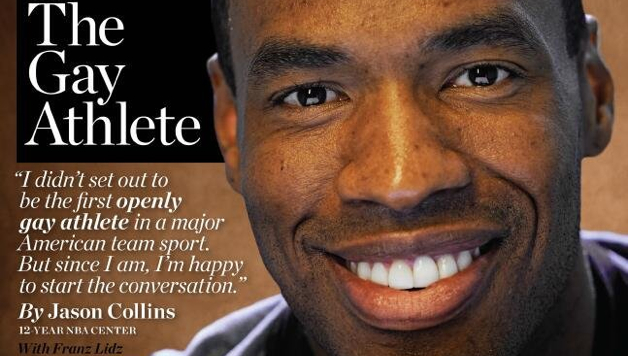
I have to be honest, Jason Collins’ admission that he is a homosexual, albeit brave, upset me. While I understand that coming out is an completely unique experience to every individual who does it, for me Jason Collins’ story was also an example of the rampant sexist and heteropatriarachal world that privileges male bodies and sexualities over those of women. While I applaud Jason’s story and the timing, the first thing I asked to my colleagues was: where was the same hubbub over Sheryl Swoopes or Martina Navratilova?
Martina Cover
As scholars, we have to be critical of the ways in which sexuality and identity politics are both utilized and taken advantage of in the public and private sector. As activists, specifically feminist and/or LGBTQ activists, we have to be diligent in maintaining a strict scrutiny of continual subjugation and objectification of women, regardless of the context.

Sheryl SwoopesPrivilege plays a major factor in discussing sexuality and sports as well as in determining the ideology that separates the gender spectrum. Men can, as Collins has shown us, “toy with the idea [of coming out],” while women who are often considered to be masculine based off of their performance and/or embodiment are therefore suspected of being lesbian for simply for playing sports as good as men.
The Gay Athlete
Jason Collins will now, and forever more--and not only as a result of tokenization and identity colonization--be known as The Gay Athlete (go ahead, google the term, let me know what images come up first). One again, the voices of the women (and men) who have clearly come before him are silenced and pushed to the back of the proverbial historical line.

While Collins’ coming out is intricately tied to feminism, his spirituality and sexuality appear to be at war with each other, specifically in his understanding of the black community and more importantly the black church. 

Growing up in a religious family active in church, Collins understood that there was another dimension to his coming out: “the stigma that being gay [in the black community] is even worse than it is in the general population.”

Not wanting to be labeled the old grumpy codger that I will most likely become down the line, I want to end this exploration of sexuality and sports by commending Jason Collins’ coming out and the conversation it is sparking not only within the professional sports world but also in both the black community and the black church.

Jason Collins wasn’t the first and he certainly won’t be the last, but he is a catalyst for change that is getting global attention. He is an open Christian, a proud gay Black man, and a role model for younger generations of LGBTQ individuals who will most certainly look up to him for years to come.
However, what he is not is the face of homosexuality within the world of professional sports. That role belongs to all members of LGBTQ community, male, female, and trans who have feared coming out and forced themselves to live a life filled with anxiety because they think they do not have a choice in the matter.

Thanks for coming (out) Jason Collins, now take a seat at the axiomatic table full of your brothers and sisters who have come before you and the ones who will most certainly come after.

Thursday, July 28, 2011

Mitt Romney Should Not Be President... For a Lot of Reasons

I have to thank my friend Kirsten for showing me the link to CNN Religion blog where Tricia Erickson's new book, Can Mitt Romney Serve Two Masters? and Dr. Richard Bushman's great, but expected response to it.

First off, let me state that I have great respect for Dr. Bushman but frankly, he is to apologetic for me. Mormonism has become a big interest of mine in the past year and although I have never taken a class with Dr. Bushman (because of personal and academic reasons) I must say that I already knew what he was going to state.

His comments: "Mormonism has become this in the recent years.." or "Mormonism is gaining more respect than just being seen as 'that weird religion with rituals and such.." but more importantly, his comment:

"Both Dekker and Erikson are one-time Mormons who became disillusioned, and instead of walking away felt an obligation to discredit their former faith" -Dr. Richard Bushman

was what I expected.

It always comes down to the issue of if you have faith or not; whether you are a faithful Mormon or not. Frankly, it's all bullshit.

It is not about faith and it is not about whether Mitt Romney is a faithful and symbolic Mormon in the 21st century. The real issue is in the second part of Erickson's title: "The Mormon Church and the Office of the President of the United States of America."

Mitt Romney shouldn't be President for a NUMBER of reasons and one of them is YES, he is a Mormon but also another one is because he is a conservative with no hint of a progressive side.

Big money for the rich, big money for the Church that he serves are all a big flashing "NO!"

Mitt Romney being President is scary, plain and simple. He is George W. Bush II, but worse. Instead of having Dick Cheney and his corporate cronies to answer to, Mitt has the Mormon Church and the GOP.

Now this is where my liberal, left-winged brain comes out and the barrier between my brain and mouth does not stop me from saying certain things. Mitt Romney should be President because he is a part of a Religion that has taken pleasure and set principles around ostracizing specific groups. From African Americans to homosexuals, the Mormon Church is not a friend to "othered" communities. (And I don't want to hear ANYTHING about how "they are changing," I don't believe it.)


When it comes to any type of progressive issue if Romney was President, the Republicans will have a say and then the Mormon Church will as well. There is just no way around it. Frankly, to any one with a liberal or progressive brain, it is a scary to think of Romney EVER being President of the United States.

Have we forgotten what the United States would have looked like if Joseph Smith had been elected President when he ran in 1844?

I hate sounding like this, like a big bigot who is "hating" upon another religion. We have freedom of religion and speech in this country for a reason but sometimes, it's that freedom that scares me the most. It scares me the most when a religion now has the power, that they once didn't have, to drastically change the lives of minority communities around the world.

I know we can say this about MOST religions, so lets call this a rant AGAINST Mormonism and Romney for the time being. I don't have the energy to write about the cruelty of religion and frankly scholars are already doing this.

I have to say that I am very afraid for what will happen if he is elected President of the United States. I do not think he can serve his "two masters" and I think the country, just like when George Bush II was President, will suffer greatly.

More importantly, while the country will suffer, "othered" communities will face a double-edged sword that never seems to go away.

Now, one can say: "Well John, you shouldn't be President because you're gay!"

I agree that we get into a slippery slope when we start classifying why certain people should or should not be President. However, we have to classify the people that would say certain things like what I have said or what I just mentioned above.

Would a progressive or democrat say that a gay individual shouldn't be President? Would a Republican say that Mitt Romney shouldn't be President?"

When thinking about these issues I find myself thinking about the latter question and coming to the conclusion that "Yes, a Republican would say Mitt Romney shouldn't be President" for many of the same reasons I have stated here. However, while I have a problem with his politics and religion, a Republican from Texas or any other Red State, would be citing his religious beliefs before his political ones.

Religion is a slippery slope. Once we start going down the path of criticizing someone's religion we find ourselves falling into a tumble and unable to stop the downward fall. However, the trouble with my rant is that not just a "liberal" is stating this about Romney, it is his own political base as well.

And that, my friends, to me is a big, symbolic, "No, No!" In a time when a two party system cannot agree on anything except Mitt Romney's religious beliefs and the trouble it would bring to the office of the President, is quite scary but all to real.

In a post Citizens United world, what type of campaign contributions will we see to Romney's Presidential campaign to propel him into the White House? More importantly, where will Romney succeed where Smith and Young failed?

Part of me hopes I never have to find out.

Tuesday, July 5, 2011

The Gay Community....or is the the Queer Community, or the Lesbian community? What Is It?!

A good friend and fellow blogger of mine posed these questions at the end of his post, "Singing the Post-Pride Blues":

From this, I extend the questions I’ve been asking myself to you. How can we overcome divisions in the LGBTQ community? What does this mean for the movement’s growth? How can we be more honest to ourselves and each other in the future?


Before I start I need to state that I do not define or situate myself in the same way that Kyle does. Where as he identifies as Queer, I identify myself as Gay. My coming out story and life experiences are in no way the same or fit into the same categorization that Kyle classifies and writes about in his writings.

I found myself puzzled when thinking about Kyle recent blog post. How can we overcome divisions in the LGBTQ community? What divisions are there and how did they get there? What historical linkages can be made from the LGBTQ (which isn't even the "latest" acronym out there in academic and activist circles) to other social movements as feminism or the civil rights movement?

The problem with inclusion, diversity, and social movements are that they serve many purposes: some good and some bad. The more freedom you give to people regarding how to identify or how to classify oneself (if you even go that far), the more factions and different individuals you have and ultimately have to satisfy.

However, within this diversity comes the reason why there is so many "inclusion" problems within the LGBTQ community.

Diversity is, in my opinion, the ultimate paradox.

Not everyone can be satisfied by a central movement. Specific groups and people can never identify the same way as the majority and then therefore become mad because their voices are not being heard and not taken seriously.

If we examine the ways the HRC and Transgendered rights have played out over the last couple of years (or just history in general) we can get a good picture in our minds about how the voices of the many outweigh the voices of the few.

While PRIDE is a time to celebrate and be happy for our diversity, I wonder if it is that exact diversity that will be our (as well as other social movements) downfall in the end?

How can we be honest to ourselves and in the future? Well that question, as my friend Kyle posed, is to me unanswerable. No one can answer that question because in today's pop-culture, academic, individualized, diverse crazy culture that we live in, no one can be ULTIMATELY pleased.

However, does that mean all social movements are left to fail? If this is the case then what are we fighting for? While its great to be a part of an organization and a movements, are we really only in it for ourselves?

I, like many people, do not know the answers to these questions, but as a person who is speaking from a privileged viewpoint, I have to ask if we will ever be able to answer or begin to answer these tough questions that could ultimately help push our movement (as well as others) forward into the 21st century.

So while we take pleasure in our post-Pride bliss and happiness, ask yourself the question: What are YOU fighting for?