Tuesday, June 11, 2013

God Doesn’t Live Here Anymore: Gay Bars and the Growing Divide Between Sexuality and Spirituality

I'm always honored to be able to mix the various lives I lead together during my monthly contribution to the Feminism and Religion Project.  I hope you enjoy this month's post and continue to check out the project! 
______________________________________

My good friend and fellow Feminism and Religion Contributor Marie Cartier’s forthcoming book, Baby You Are My Religion: Women, Gay Bars, and Theology Before Stonewall argues that American butch-femme bar culture of the mid-20th Century should be interpreted as a sacred space.  Specifically, gay bars served as both communal and spiritual gathering spaces where butch-femme women were able to discover and explore not only their sexuality but also their spirituality.  An opus of an academic accomplishment based off of the amount of in-depth interviews she conducted, Professor Cartier explores lived religion in an area that has become all too common within the LGBTQ community: the bar

The Palms, the last local and only lesbian bar to be found in city of West Hollywood, CA is closing its doors and I can’t help but wonder where its patrons or parishioners will now go?

With its closing, specifically at the end of L.A. Pride weekend, where thousands of LGBTQ individuals flock to West Hollywood to celebrate what makes our community truly unique, one has to begin to wonder where, if Professor Cartier’s thesis holds true, God has gone? 

The Palms
Does God exist within the LGBTQ community anymore or has the community itself abandoned God for all-night raves, dance clubs, alcohol, and hypersexualized and over commoditized fetishized forms of femininity and masculinity?  Oftentimes, I find myself answering yes to the above questions.  After surviving hate crime after hate crime and endless batches of newly elected conservative politicians hell bent on ignoring medical and social epidemic plaguing the very country they were elected to serve and protect, why would a community, oftentimes linked to sin itself, believe in a holy entity?

The overarching question at hand in regards to the closing of the Palms is not whether or not there is a space for God in the LGBTQ community anymore but rather what role does misogyny play within the very community sworn to respect and take pride in the very differences that makes itself truly unique?  Scholar Ann D. Braude credits the success of religion to the active and oftentimes overwhelming support of women.  With 40% of West Hollywood’s 35,000 residents identifying as gay but only 3% identifying as lesbians one can deduce that the closing of the Palms signifies the growing divide between the LGBTQ community and spirituality as more women leave the proverbial "church spaces" that they have created.  

The success of the LGBTQ community cannot be tied exclusively to gay men but also the struggles and successes of the lesbian community.  Similar to the various ways in which women helped religious communities boom throughout the 18th, 19th, and 20th centuries in America, the lesbian community, as a whole, is integral to not only the successes of the LGBTQ community and the very cities and spaces they have helped to found.  

With the exodus of women, so comes the migration of spirituality itself and one can only wonder, whether or not, there will ever be any room or spaces left for women where more individual are becoming continually transfixed by Adonises and abdominal muscles. 
If Professor Cartier’s thesis does hold true, we have to begin to wonder if women are fleeing and God is following them, where might they be looking for a new lease?

Tuesday, May 14, 2013

Thanks for Coming (Out): Sexuality, Sports, and Spirituality

Qualifying exams, disseration proposal, full time job, a boyfriend, friends, advocacy work, and maintaining a social life are all things that take up most of my time.  However, I am always grateful to the individuals over at Feminism and Religion who continually give me the opportunity to talk about items that interest me with a community of both activists and scholars dedicated to changing the world. 
________________________________________________________________________________
Like marking off items on a proverbial checklist, closeted LGBTQ individuals who exist within and outside of the world of professional sports, can recount the numerous things they struggle with in terms of their sexuality. From fearing the actual coming out process, dressing in their car or at home to avoid the subtle glances and whispers of individuals in the locker room, to wondering what coming out would mean not only for their game but also for their social and if they choose, spiritual lives, closeted and out LGBTQ individuals within the multi-billion dollar professional sports industry must grapple with that age old question: what does it mean to be gay and open about it?
The Locker Room
I have to be honest, Jason Collins’ admission that he is a homosexual, albeit brave, upset me. While I understand that coming out is an completely unique experience to every individual who does it, for me Jason Collins’ story was also an example of the rampant sexist and heteropatriarachal world that privileges male bodies and sexualities over those of women. While I applaud Jason’s story and the timing, the first thing I asked to my colleagues was: where was the same hubbub over Sheryl Swoopes or Martina Navratilova?
Martina Cover
As scholars, we have to be critical of the ways in which sexuality and identity politics are both utilized and taken advantage of in the public and private sector. As activists, specifically feminist and/or LGBTQ activists, we have to be diligent in maintaining a strict scrutiny of continual subjugation and objectification of women, regardless of the context.

Sheryl SwoopesPrivilege plays a major factor in discussing sexuality and sports as well as in determining the ideology that separates the gender spectrum. Men can, as Collins has shown us, “toy with the idea [of coming out],” while women who are often considered to be masculine based off of their performance and/or embodiment are therefore suspected of being lesbian for simply for playing sports as good as men.
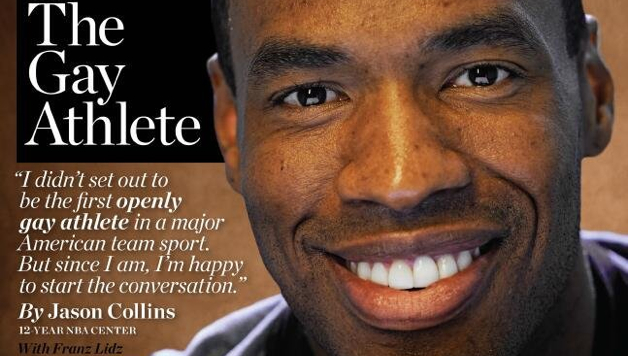
The Gay Athlete
Jason Collins will now, and forever more--and not only as a result of tokenization and identity colonization--be known as The Gay Athlete (go ahead, google the term, let me know what images come up first). One again, the voices of the women (and men) who have clearly come before him are silenced and pushed to the back of the proverbial historical line.

While Collins’ coming out is intricately tied to feminism, his spirituality and sexuality appear to be at war with each other, specifically in his understanding of the black community and more importantly the black church. 

Growing up in a religious family active in church, Collins understood that there was another dimension to his coming out: “the stigma that being gay [in the black community] is even worse than it is in the general population.”

Not wanting to be labeled the old grumpy codger that I will most likely become down the line, I want to end this exploration of sexuality and sports by commending Jason Collins’ coming out and the conversation it is sparking not only within the professional sports world but also in both the black community and the black church.

Jason Collins wasn’t the first and he certainly won’t be the last, but he is a catalyst for change that is getting global attention. He is an open Christian, a proud gay Black man, and a role model for younger generations of LGBTQ individuals who will most certainly look up to him for years to come.
However, what he is not is the face of homosexuality within the world of professional sports. That role belongs to all members of LGBTQ community, male, female, and trans who have feared coming out and forced themselves to live a life filled with anxiety because they think they do not have a choice in the matter.

Thanks for coming (out) Jason Collins, now take a seat at the axiomatic table full of your brothers and sisters who have come before you and the ones who will most certainly come after.

Tuesday, February 12, 2013

Second Class Rape Victims: Rape Hierarchy and Gender Conflict

While most of my life has been dedicated to studying for my qualifying exams, finishing up a few book chapters, and working for the City of West Hollywood, I am constantly thrilled for the opportunity to step away from it all and engage in these thought provoking conversations.  I hope you enjoy this blog and visit the Feminism and Religion Project to view the new conversation occurring in the field.  
____________________________________________________________________

The most disturbing part of the 2006 documentary Deliver Us from Evil isn’t that fact that Father Oliver O’Grady is rewarded by the Catholic church with a new congregation in Ireland after his short stint in prison for the rape of dozens of children in the 1970s but rather the hierarchy of gendered victimization which is often created throughout the various rape cases that both are reported and unreported throughout history.  

Deliver us from Evil
I am often troubled by the ways in which rape cases are discussed and even deconstructed via the mediums such as blogs, online communities, social media networks, the news, and popular culture.  No series of events troubled me more than the Jerry Sandusky trial but more importantly, the ways in which the young boys and adult men who were subjected to Sandusky’s abuse quickly overshadowed the other rape cases that are reported on a daily basis, specifically those involving young girls and women. 

Our country needs to have a serious conversation about the ways in which masculinity is not only constructed but also deconstructed through the acts of rape, incest, sexual assault, domestic violence, and virility.  How do these horrific actions pinpoint and break apart the depiction of the hegemonic and virile man who is impenetrable.  How do these acts, which have historically occurred throughout time, gain greater significance in our 24hr news cycle, tech obsessed culture? 

Although the rape of a women on a bus in India by six men didn’t go unnoticed by the world, I have to wonder what would have happened if her story would have occurred on November 4th, 2011, the date when a grand jury, who had convened in 2008, indicted him on 40 counts of sex crimes against young boys.  Would it have gotten the same amount of attention it did when it came across U.S. news screens on December 16th, 2012?  Would the outcry from women across the world silence those of both Penn State as well as various other sports fans and individuals from across the United States? 

What these events and society’s obsession with them for the weeks and months and even year after signify isn’t that more attention is being given to violent sexual crimes against all types of bodies but rather a resignification of the hierarchy that is already all too present within our culture today: stories about men in all forms get top billing. 
Upon asking a small groups of friends whether or not they have heard about the rape case involving the Indian woman on December 16th, 2012 or even the rape of an elderly bird-watching woman in Central Park in September 2012 the resounding silence pinpointed the reasons why, when asked whether or not they had heard about Jerry Sandusky, their answers were an unequivocal yes.

sanduskyx-large
While the activist in me wanted to cry out and scream “Are you serious!” the scholar in me knew to take a step back and examine the situation from various angles.   

Why are violent crimes against women cast aside in light of new stories that involve men sexually or violently abusing young boys or other men?  What about masculinity makes it seem both impenetrable and innately hegemonic? 

While we could reduce the actions down to the violent response men have when any form of their power and social/sexual status is threatened, we have to step back and examine the issue about the innate power that men are endowed with not only through social institutions but also religious ones as well.

Men are seen as “on top” both figuratively and literally throughout the various images that bombard both young girls and boys immediately from the expulsion of their mother’s womb (and some would argue even before their expulsion).  From early on, young boys are taught that they are #1 and that “the other,” i.e., the young girl, is not only below them but also an object that they must possess, whether through violent action or the eternal dance of courting.   However, when there is a disruption to this innate system of power structures, the response that we often see is one of violence.  While men are taught that they should not show emotion or deviate from the heteronormative society acted out in front of them on a daily basis, their crisis of masculinity often comes with the inability to negotiate what their identities as men actually mean to themselves personally.  Giving men the ability and space to discuss what their masculinity means to them creates the opportunity to change the narrative of “men on top.”  From small ripples of change that eventually overtake the mainstream current, deconstructing masculinity during times when violent actions are inflicted upon male bodies creates a new chance for scholars and activists to draw attention to not away from the victims at hand but rather into the larger narrative of social, sexual, and domestic violence that occurs all around the world every day to all types of bodies. 

Deconstructing masculinity isn’t the key to solving social, sexual, and domestic violence across the world but it is a step worth taking when attempting to engage men in affecting change to stop these violent actions since men, statistically are the perpetrators of such crimes that both cause such outcry as well as perpetual silence. 

WDYS-Banner-resizeforwebsite

(I was fortunate enough to get to spend some time this month talking with Dr. Gina Messina-Dysert at lengths about our lives, our careers, and like with most scholar/activists eventually about the topics we are passionate about.  Always a source of inspiration, Gina frequently helps me hash out the many topics I’m interested in writing about and pointing me in the right direction. This post (and the blog it is housed on) would not be possible without her continual presence as a force for change and progress within Feminist and Religious communities.)