Showing posts with label Feminism. Show all posts

Tuesday, February 14, 2017

Welcome to the Resistance

There comes a time in everyone’s life when you have to make important decisions. What do I believe in? Who do I want to be? What and who will I stand up for? There has been a lot going on in the world lately and a lot of it, sadly, is pretty awful. While people are learning pretty quickly that elections have very real and long-lasting consequences, what is critical to overcome the next 4-years of this fascist regime isn’t just that we are taking to the streets to make our voices heard but we are willing to disrupt society at every turn to make sure that people on the other side of the proverbial political coin know we will not go gently into that good night.
I’ve been questioning G-d a lot lately; wondering what has happened to that shining “City on a hill” that John Winthrop called for in his 1630 sermon “A Model of Christian Charity.” The idea that the United States of America is “G-d’s country” due to the American exceptionalism present but not only the rich bounty of land and resources many would soon land upon but also the potentiality that America represented in a world full of monarchs.
Many Presidents have often recited the very same idea to the American populous. From John F. Kennedy to Ronald Reagan, America, although diverse and full of various communities from all walks of life, always presented a rich idea that we would be a beacon for prosperity, freedom, and dreamers. For myself (and many others I’m sure), that idea was called into question on November 8, 2016. We had come so far in the struggle for and the potential achievement of the “American Experiment” to fall before we got to the top and, as we have all felt since then, hit every jagged rock on our journey back down to the bottom. However, what we need to remember is that we’re not anywhere close to the bottom yet; all the symbolic bruises and scars we each have will only continue to grow as we keep tumbling down the rabbit hole.
Although the hits keep coming I refuse to let them get me down. I refuse to sit back and watch the country and communities I love be attacked by a tyrant and his cronies looking to cash in on people’s lives.
john-pershing-square
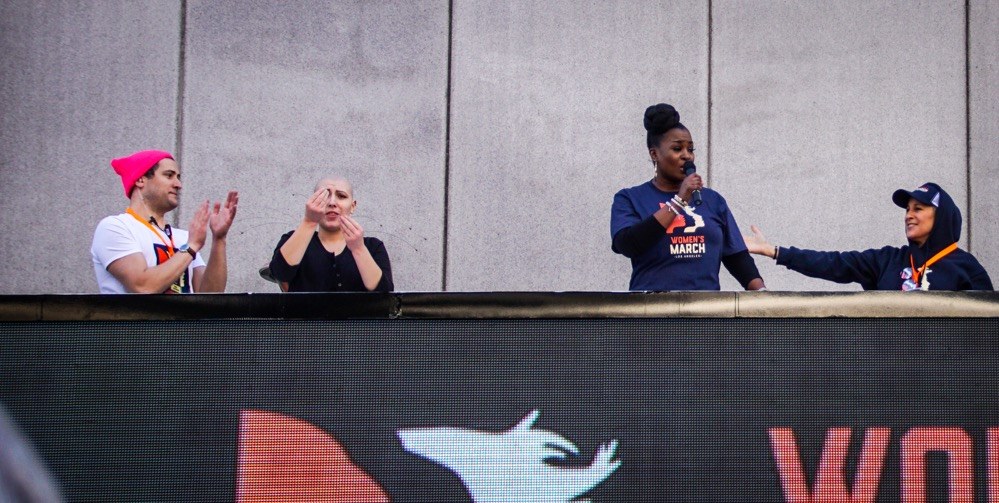
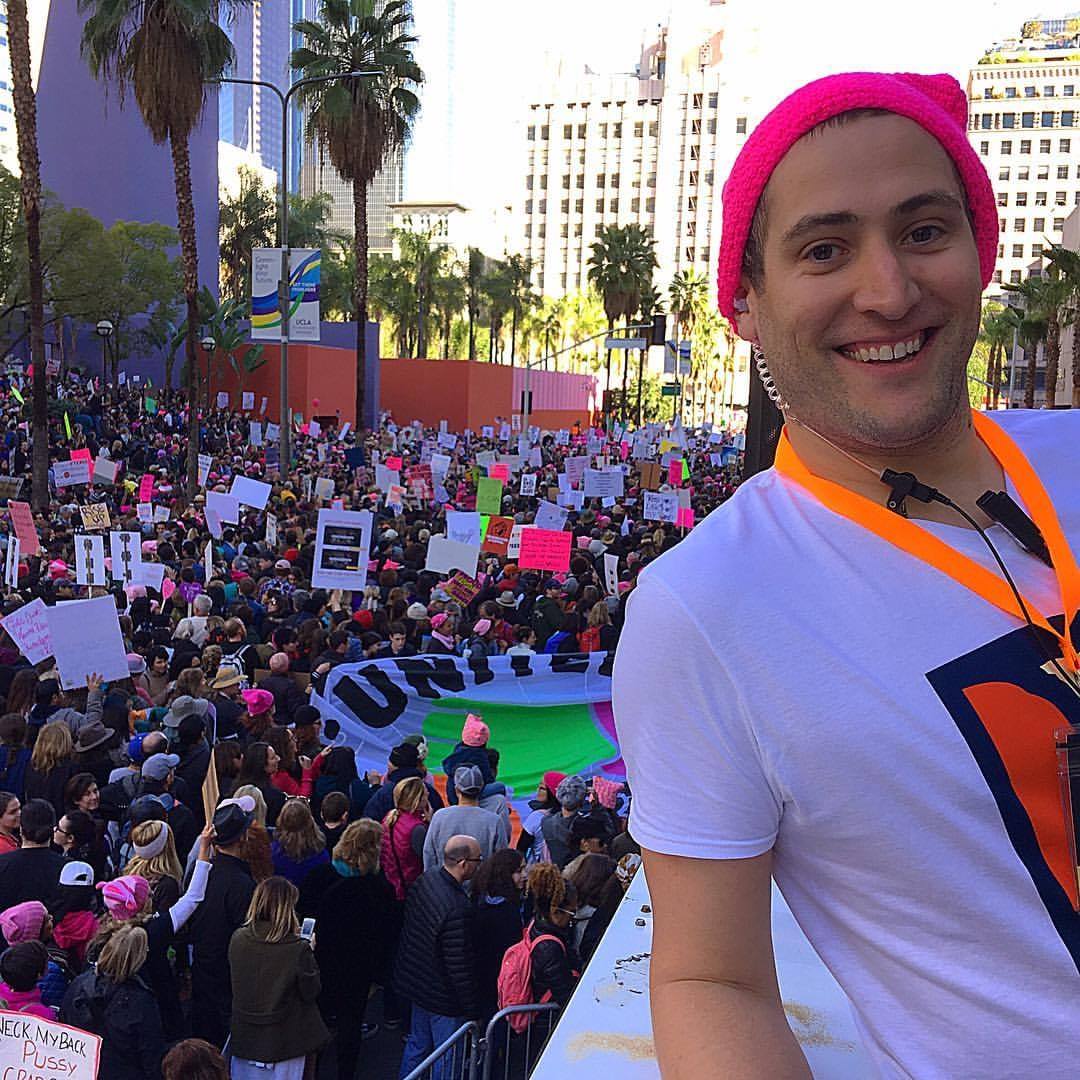
On January 21, 2017, I saw the resistance rise. For me, the Women’s March was more than just 750,000 people from all walks of life taking part in a communal action across the world, it was an accumulation of what is not only possible but also the hope and dream of what is still to come.
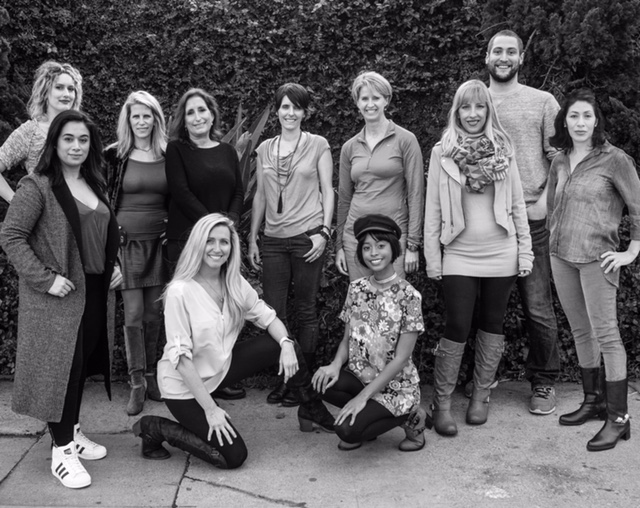
What a lot of people do not know is that while I too, was a part of the crowd, I was also behind the scenes working on the march here in Los Angeles. I was fortunate enough to be 1 of the 13 co-organizers of the march which consisted of a group of women I now call my heroes.  Although I do not think that I’ll ever be able to put into words what the march or being part of its organization means to me, the one thing I do know for sure, now, more than ever, is that we are always stronger together.
img_0310
At the march, we went from “I” to “We.” We became part of something that we will never be able to understand. If that isn’t G-d, I do not know what else it would be. While November 8 had me questioning my faith, January 21 brought it back full force.
The night before the march, I was with three of my closest friends. We laughed, we cried, we shared in the love that we have for this country and most importantly, the love we have for each other. Falling asleep that night, the following quote kept me awake at night and I didn’t understand why until I got home after the march. The quote is:
The Devil whispered in my ear,
“You’re not strong enough to withstand the storm.”
Today I whispered in the Devil’s ear,
“I am the storm.”
While I believe the quote is perfect as it is, the only thing that I’d change is that on January 21, “I” didn’t just whisper in the Devil’s ear, “We” did.
Welcome to the resistance, my friends. The march happened. We all went home changed and more awake than ever before. Now, the only remaining question I have for you is: what’s next?
john-womens-march
John is a Ph.D. Candidate in American Religious History at Claremont Graduate University and holds an MA in Women’s Studies in Religion; an MA in Applied Women’s Studies; and a BA in English and Women’s Studies.  His areas of focus are women’s, gender, and sexuality studies, LGBT history, American religious history, and 20th and 19th-century American women’s history.  John is currently the Community Events Technician for the City of West Hollywood where he works on community events related to women, gender, sexuality, and human rights issues.   

Tuesday, June 2, 2015

The Religiosity of Silence

In 2013, I wrote an article about the then latest reality TV scandal featuring A&E’s Duck Dynasty’s Phil Robertson and his rampant foot-in-mouth disease that caused him to express his true distaste for the LGBT community and mainly the sexual proclivities of gay men in the pages of GQ.

1432305381_josh-duggar-speaking-467Now, two years later, it isn’t Josh Duggar’s, star of TLC’’s ’19 Kids and Counting’, anti-LGBT statements getting him into trouble but rather his sexual assault and molestation of 5 girls, including two of his sisters. However, while the Internet explodes with attacks against Josh Duggar and his Quiverfull background it is vital to remember that the silence that he and his family inflicted upon his victims back in 2006 has not only been ongoing since then but also is being reemphasized today with each keystroke focusing on the assailant rather than the victims.

Starting in the 1980s, “Quiverfull,” the religion that the Duggar family image0012adhere to, spread through various evangelical circles with principles focused around biblical literalism such as: traditional gender roles, emphasis on family values, and a scorn and fear of the secular (read: modern) world. Furthermore, while having lots of kids in the Quiverfull religion isn’t just about building up one’s quiver but rather reemphasizing the way in which the world should be run: with women as subservient child producers who are taught to be silent no matter what hardships they face. Josh Duggar and the rest of his Quiverfull family exist in and perpetuate a culture of silence that emphasizes the male struggle while demeaning a woman’s pain as being a result of her having a sinful heart. It should be no shock then to find out that in a world of silence those who are affected the most by silence find it the most difficult to not only speak out but also be heard when men rule the roost.

While the facts surrounding the culture of silence in regards to assault and molestation are shocking, some other facts emphasize why the case against Josh Duggar is all too real: acquaintance perpetrators are the most common abusers making up almost 70-90% of all perpetrators with 89% of child sexual assault cases involving persons known to the child, with 29% of child sexual abuse offenders being relatives and 60% being acquaintances.
In a repetitive culture of abuse and silence, is it really shocking to find out that an individual who preached such hate and discontent for others actually perpetuated other forms of heinous abuse against others?

To say that I was shocked by the revelation about Josh Duggar’s past would be a misnomer; however, to say that I don’t care would be an outright lie. I do care about what happened because I care about the 5 girls he molested and I care about what happens to them now and in the future when they are no longer silenced and are allowed to be free and feel the pain and hurt he inflicted upon them all those years ago in a new light.


We need to hear their voices, we need to hear their stories and more importantly, we need to stop giving the headline to the name “Josh Duggar” and start giving it back to the young girls, not only in Arkansas but also around the world who are forced to live their lives in silence and fear and without the hope that their assailants, regardless of whether or not they were the son to a multi-million corporate television reality cash cow or just a regular person walking down the street.

Sexual assault and violence know no gender and in the case of Josh Duggar, the main thing we need to remember that although he got caught, he probably never stopped and even more terrifying is: who will stop him now that he is the head of his household with four young kids in his quiver?
1269118475802760230
John Erickson is a Ph.D. Candidate in American Religious History at Claremont Graduate University. He holds a MA in Women’s Studies in Religion; an MA in Applied Women’s Studies; and a BA in Women’s Literature and Women’s Studies. He is a Permanent Contributor to the blog Feminism and Religion, a Non-Fiction Reviewer for Lambda Literary, the leader in LGBT reviews, author interviews, opinions and news since 1989 and the Co-Chair of the Queer Studies in Religion section of the American Academy of Religion's Western Region, the only regional section of the American Academy of Religion that is dedicated to the exploration of queer studies in religion and other relevant fields in the nation and the President of the University of Wisconsin Oshkosh's LGBTQA+ Alumni Association. When he is not working on his dissertation, he can be found at West Hollywood City Hall where he is the Community Events Technician and works on policies and special events relating to women, gender, sexuality, and human rights issues that are sponsored or co-sponsored by the City of West Hollywood. He is the author of the blog From Wisconsin, with Love and can be followed on Twitter @JErickson85

Wednesday, September 25, 2013

Truths My Mother Taught Me

Today is my mother's birthday and I'm so lucky that I have a space like Feminism and Religion to talk about not only her but also my journey.

Happy Birthday Mom!  I love you!
_____________________________________________________________

Graduation Photo
The first question I always get asked when I’m in feminist spaces is: “What inspired you to become a feminist?”  Although I could go into the various histories revolving around men’s involvement in the early stages of the women’s movement to the similarities between the LGBTQ and women’s movements, my simple answer has always relied on one person: my mother. 

I’ll be the first to admit (as well as many other people who will join me in the same chorus) that my mother deserves Sainthood for having put up with all the shenanigans I put [and still continue to put] her through.  From running away from our local Catholic church the moment she dropped me off at Sunday School, to swearing like a sailor on leave at a very early age in front of Father Schmidt (who still fondly remembers me and the list I brought in with me to the confessional booth), I taught my mother a few things I do not believe she would had ever thought she'd know during her lifetime. 

Although I pride myself on my rejection of religion, the best lessons that I’ve learned ultimately deal with and relate to the thing I thought I swore off long ago.  I am a feminist because of a Catholic woman who refused to take no for an answer on Sunday mornings because going to church wasn’t about listening to the Priest but rather listening to and learning from the woman who brought me there.  I may have hated sitting in the pews every Sunday but it was there, in that space, where I began to learn what I now love so much.  Though some people may refer to this as lived religion, I suggest that it is more relatable when we refer to it as experiencing religion.  Lived religion, for me, implies past tense, something we’ve studied or done years, days, or even minutes ago.  Experiencing religion is an on-going process, one that happens in the now rather than in the future.  My mother left me when two other truths I’ll never forget:
1.)  Love is love, whether divine or earthly, love does conquer all.
2.)  Trust G-d by trusting in yourself. 

Mom and I
I still remember the day my mother drove away, leaving her baby and only son behind to pursue his dreams of getting a graduate degree in Women’s Studies.  I was scared and I didn’t know whether or not I’d come running home to Wisconsin a week later.  

As the white P.T. Cruiser we rented pulled out of the graduate housing complex I lived in, her words: “I’m so lucky to have a son like you,” resonated in my head.  For the first time, I felt some semblance of divinity watching over me because I trusted my choice and myself.  Trusting in myself led me to find G-d in whatever form he or she chooses to greet me in, I just have to be willing to open the door.

I’m still reminded of my mother’s parting words and the feeling I got each time I board a plane to go wherever those dreams and choices take me.  However, this time, instead of hearing her say that she is the lucky one, I just chuckle, and smile as the plane lifts off the ground, and realize that it is I who is the lucky one. 

I never gave much credence to religion but through my mother, I met G-d, and through her I understood that I’m not a feminist because of the books I’ve read or the degrees I acquire but rather because of the woman I call mom. 

Happy Birthday Mom!  I wish I was there to celebrate with you in Wisconsin.
Mom and Brady

Tuesday, July 9, 2013

To Have and to Hold: Gay Marriage and the Religion Question

I feel especially honored to have worked for a City that not only prides itself on human rights but also is a constant beacon to the community and the world, specifically during this critical moment in LGBT history.  If one boy, from Ripon, WI can hear the equality ringing from the streets of West Hollywood when he was younger, then I can only imagine what's next and how the City will continue to change the world for the better.  

This blog dedicated to both the City that I now call home but also the Feminism and Religion community that I am constantly honored to write for.  
_____________________________________________________________

gay_marriage_81102178_620x350Outrage. Anger. Fear. Hatred. These are just a few of the words that flashed across my Twitter feed as I woke up on that fateful Wednesday, June 26 morning when the Supreme Court of the United States ruled that the Defense of Marriage Act (or DOMA) was unconstitutional and that supporters of Proposition 8, the hotly contested voter initiative in California that banned same-sex marriage, had no standing. People were mad. However, it wasn’t just the typical kind of mad that is associated with hatred, it was a type of mad that was met with impossible anguish because what I was reading and feeling was a result of one thing: there was nothing more they could do.

What does all this mean? Questions from friends and family were filling up my inbox and although I wanted to take a moment to just hit “Reply All,” and input the words: Equality, I had to hold back and start to examine the notion that although equality may now be firmly on the proverbial table, there is still a lot of work to be done, specifically for gay marriage and those wanting to marrying inside the traditional church spaces they grew up in and not just the ones that have come out as open and affirming in recent years towards LGBT individuals.
lesbian-same-sex-marriage
The ongoing shift of public opinion in support of gay marriage and LGBT rights in recent years is encouraging but it still is only one piece of the puzzle. Working for the City of West Hollywood has granted me the opportunity to see first hand the beauty and the work still left to be done. Although organizations such as California Faith for Equality or Equality California are doing an excellent job in recruiting faith-based communities and other religious organizations to join the fight for LGBT equality within religious communities the work and conversations that need to still occur outside of open and affirming churches is becoming a daunting and often overwhelming force of opposition. The amount of individuals who still do not support gay marriage or LGBT rights in general in conservative and oftentimes hyper patriarchal religious traditions such as Catholicism, Mormonism, Islam, Judaism and other conservative Evangelical traditions still remains a daunting number and it only appears to be growing now that there has been such a public declaration from public policy and legality standpoints that echo Hilary Clinton’s famous words that: “gay rights are human rights.”

The question that remains is not why do these religious groups not support gay marriage or LGBT rights in general but how are individuals, typically on the outside, supposed to convince members of these faith-based traditions to leave or possibly change their opinions if they still remain steadfast and stubborn on other progressive causes that are often discussed on this very blog. Women’s ordination, sexual ethics, women’s rights, and theological and religious equality in general are just a few causes that individuals on the outside believe would be no brainers when compared to tackling the issues of gay marriage and LGBT rights but still we have on-going and often exhaustive conversations about ensuring the full rights of women in faith-based traditions and communities.

The other question that remains may seem to be the icing on the cake but it is really the tip of the iceberg when we discuss issues like equality within religion: if people refuse to leave their religious traditions and communities when women, who are oftentimes the reason for the very success of not only religion but also faith-based communities in general, then do we really think or expect that they’ll leave when their LGBT brothers and sisters are also denied that same type of recognition but on top of it constantly told they are sinners and are going to hell? If a conservative religious traditions can’t give their mothers or sisters full equality, how can we expect them to give LGBT individuals the time of day?

Gay-MarriageThe issue of equality doesn’t just stop at gay marriage and LGBT rights but only begins there. Women’s rights, women’s ordination, and even the idea of a woman President are the only a few of the other pieces of the equality puzzle anxiously awaiting to be put together. As we have seen with the fight for equality, groups are banding together now more than ever before and although gay marriage may be on the front page of newspapers today, who knows what tomorrow could bring.


Tuesday, June 11, 2013

God Doesn’t Live Here Anymore: Gay Bars and the Growing Divide Between Sexuality and Spirituality

I'm always honored to be able to mix the various lives I lead together during my monthly contribution to the Feminism and Religion Project.  I hope you enjoy this month's post and continue to check out the project! 
______________________________________

My good friend and fellow Feminism and Religion Contributor Marie Cartier’s forthcoming book, Baby You Are My Religion: Women, Gay Bars, and Theology Before Stonewall argues that American butch-femme bar culture of the mid-20th Century should be interpreted as a sacred space.  Specifically, gay bars served as both communal and spiritual gathering spaces where butch-femme women were able to discover and explore not only their sexuality but also their spirituality.  An opus of an academic accomplishment based off of the amount of in-depth interviews she conducted, Professor Cartier explores lived religion in an area that has become all too common within the LGBTQ community: the bar

The Palms, the last local and only lesbian bar to be found in city of West Hollywood, CA is closing its doors and I can’t help but wonder where its patrons or parishioners will now go?

With its closing, specifically at the end of L.A. Pride weekend, where thousands of LGBTQ individuals flock to West Hollywood to celebrate what makes our community truly unique, one has to begin to wonder where, if Professor Cartier’s thesis holds true, God has gone? 

The Palms
Does God exist within the LGBTQ community anymore or has the community itself abandoned God for all-night raves, dance clubs, alcohol, and hypersexualized and over commoditized fetishized forms of femininity and masculinity?  Oftentimes, I find myself answering yes to the above questions.  After surviving hate crime after hate crime and endless batches of newly elected conservative politicians hell bent on ignoring medical and social epidemic plaguing the very country they were elected to serve and protect, why would a community, oftentimes linked to sin itself, believe in a holy entity?

The overarching question at hand in regards to the closing of the Palms is not whether or not there is a space for God in the LGBTQ community anymore but rather what role does misogyny play within the very community sworn to respect and take pride in the very differences that makes itself truly unique?  Scholar Ann D. Braude credits the success of religion to the active and oftentimes overwhelming support of women.  With 40% of West Hollywood’s 35,000 residents identifying as gay but only 3% identifying as lesbians one can deduce that the closing of the Palms signifies the growing divide between the LGBTQ community and spirituality as more women leave the proverbial "church spaces" that they have created.  

The success of the LGBTQ community cannot be tied exclusively to gay men but also the struggles and successes of the lesbian community.  Similar to the various ways in which women helped religious communities boom throughout the 18th, 19th, and 20th centuries in America, the lesbian community, as a whole, is integral to not only the successes of the LGBTQ community and the very cities and spaces they have helped to found.  

With the exodus of women, so comes the migration of spirituality itself and one can only wonder, whether or not, there will ever be any room or spaces left for women where more individual are becoming continually transfixed by Adonises and abdominal muscles. 
If Professor Cartier’s thesis does hold true, we have to begin to wonder if women are fleeing and God is following them, where might they be looking for a new lease?

Tuesday, December 11, 2012

Don’t Worry, I Won’t Marry Your Girlfriend: Sexuality, Identity, and the Easy Laugh

Although finals are upon us and I am busy doing a multitude of things, I always welcome the ability to take time out of my day to blog for the Feminism and Religion Project.  I hope you enjoy this post and are both able to laugh and reflect upon the serious issues at hand.
________________________________________________________________________

I must say, I will be the first to admit that the recent outbreak of videos promulgating the idea that gay men will marry a straight guy’s girlfriend or lesbians will marry a straight girl’s boyfriend all for the sake of marriage equality left me stifling my laughter as I attempted to pay attention in class.

However, after the calamity died down I took a moment to reflect upon the intrinsically embedded aspects of misdirected norms of sexuality, gender, and misogyny latent within the laugh lines and the guffaws throughout each video.


The images that are present within each video not only work to reinforce the cultural and sexual stereotypes that propagate that ideas that gay men are inherently more sophisticated that their heterosexual counterparts (as well as better dressers) or that lesbians are just like a straight girl’s boyfriend who loves videogames, sports, and beer (and has no problem with his World of Warcraft Addiction) but also work towards breaking down the proverbial bridge that activists have attempted to build between individuals and groups, such as religious organizations, in order to get them to not see the error of their ways, but rather understand that love and committment, comes in multiple forms.

Although these videos were created to shed light on some of the issues that are present within popular culture as well as to get the easy laugh and adoration of fans from across the world who are fighting for marriage equality, the creators must be held accountable for the responses that have developed as a result of the challenge each of these videos presents to heterosexual society.  These videos dare to tackle the inborn quality that men not only should marry women but also that they are suppose to marry them as an acquisition of property rather than an object of affection.


These videos create a world that is reinforced by the idea that straight men have something to fear from gay men and that both gay and lesbian individuals are lacking an important aspect that signifies their identity as a member of society: the acquisition of a woman.  The dialogue that remains, after we essentially walk through the proverbial smoke and mirrors that these videos create, is both dualistic and reductionist at best.  No longer having to deconstruct the larger cultural and sexual narratives, heterosexuals who do not support marriage equality or feel threatened by homosexuals return to their one source of power that reinforces the ideology that they are on the right path: the Bible.  “Marriage is between a man a woman,” or “A man shall not lie with another man as he would a woman,” becomes the newly reinforced heterosexual rallying cry and the progressive progress that occurred in the past becomes nothing more than a joke.

Although these videos make it difficult to ignore the issue at hand without breaking into a fit of laughter, the issue of equal rights or marriage equality should never be reduced to a laugh line. 


Tuesday, October 9, 2012

Visions of My Grandmother

Writing has been very hard lately.  With classes, teaching, and working in West Hollywood, I often find myself wanting to lay on the couch more than read a book or write a blog post.  However, I am continually honored to be a part of the Feminism and Religion Project and I hope you enjoy my post this month.

xoxo
John
_____________________________________________________________________
I haven’t dreamt of my grandmother since her passing one hot summer July evening.

The night, and the days that followed, continue to be a blur.  However, as my family members continue to see her in their nightly visions, I, go on unabatedly longing to see and hear the voice of a woman who made me feel the presence of the divine with each passing story. 

My sister saw her in a dream when she was buying shoes, my mother has seen her multiple times when she would be undergoing a particularly stressful situation, and I, left alone and oftentimes wondering through an abyss of loneliness and disarray, wake up each morning wondering why, I am left all alone.

We often question the divine, his/her intentions, and specifically whether or not we will ever see resemblances of those long gone in our daily lives, but I’m here to ask and ponder whether or not my inability to see my grandmother has to do with the fact that she was the one person I was not honest to during her lifetime.    

I never told my grandmother I was gay.  I’ve often wanted to visit her grave, clench my hands together, and pray that she forgive me for betraying the trust she instilled upon me long ago.  However, even today, I cannot bring myself to make that trek, up the hill into the countryside where her ashes lay below the ground.

Yes, my grandmother would meet the boys I was dating and yes, I would talk about my life in a way that it would be obvious to anyone else that I was gay, but I never uttered the words, “Gladys, I’m gay” to her.  I could handle rejection from my parents, I could face the dismissal from certain family members, but her rejection, the rejection of my hero and best friend, was one thing I was not willing to face.

The only time she ever entered into my dreams was a year ago when I found myself entering her house and seeing her sitting in her chair with its back turned towards me.  I called her name, I kept questioning whether or not she had heard me (she was always hard of hearing), and the more I called out her name the more she just sat there, in her chair, silent, and unable to  turn around and look at me.  

How does one who doesn’t really believe in the divine pray?  How do we manage the complex emotions that we feel when loss and heartache overcome our power in faith?   More importantly, who, when we are unable to deal with the guilt and pain we have inside, do we agnostics pray to? 

I’ve never really pray, but when I do I pray to my grandmother.  I do not pray to a God or Goddess that I do not know exists or not, but rather an entity who I hope still watches over me. 

However, like with many of the prayers that we cast into the unknown, I too find myself on the same boat, hoping that one day, my divine grandmother will forgive me of my sins and welcome me back into her loving arms.

I look forward to finally walking into her house in my dreams and seeing her warm smile greet me at the door but until then, I’ll continue to sit here and pray. 
 

Tuesday, September 11, 2012

8 Simple Rules for Being a Queer Godfather

This month I decided to write about an event that changed my life: the day I became a Godfather.  I am honored that I am able to write about issues on the Feminism and Religion Project but proud that I have the ability to share my story with our readers.  Enjoy.

xoxo

________________________________________________________________________________
I often wondered why I wasn’t asked to be the Godfather of my niece and nephew.  It made perfect sense to me that I would be the best person to guide and provide spiritual care for either of them as I was the only member, in both my family and my brother-in-law’s, getting a PhD in Religion.  I didn’t think there would be much to it.  I would go, hold my nephew, and watch a priest pour water over his head, and then go and enjoy some very sugary cake in my sister’s backyard. 

On August 18th, 2012 my wish came true and I became the Godfather to my sister’s second child, Drew.   I had always believed that there was nothing to being a Godfather.  That it was a title in name only and a tradition that many individuals bestowed upon members of their family as ritualistic habit rather than a sacred institution of spiritual care and upbringing.  Boy, was I wrong.

In various posts housed on this blog, authors discussed their hopes for the future and their wish to change the systems of domination that many believe to be a source of entrapment in specific religious traditions.  As an advent agnostic, I always found religion to be an interesting force of social control rather than way of life that some people believe it to be.  Becoming a Godfather was more than just a reentry into the Catholic traditions I had long given up but rather a journey back in time that would grant me the ability to rewrite the wrongs I felt as a kid growing up in a tradition I not only didn’t understand but also didn’t feel like I belonged in. 

Looking into my nephew’s eyes as he quietly sat in my arms while the priest poured water over his head, I made a wish for my nephew and said my first prayer in a long time:

Dear Nameless Deity,I know I haven’t been the most faithful as of recent but I want you to know that I promise to take my role as Godfather seriously.  I understand now that Drew’s journey is just beginning and that I am here to help him along his way.  Bestow me with the ability to answer Drew’s questions when he gets older and to be there to guide him through life as a friend in his spiritual journey rather than an authority who dictates instead of listens.  Keep him safe and keep him in your thoughts, amen. 

(Me Holding My Godson Drew, my mother holding my nephew Brady, and my niece Emma dancing)

I realized that I wasn’t going to be the a-typical Godfather.  As a self-identified queer male, I realize that Drew, if raised in the same traditions that I was, would one day have questions not only about faith but also about his Uncle and now Godfather.  How would I answer them and more importantly, what would I say when and if he ever asked me if I was going to hell? 
While he slept in my arms I came up with 8 rules I promised to live by when and if Drew ever would require the spiritual guidance I was sworn to deliver.  I reinvented the tradition to create a better future for my Godson rather than the recapitulate the dominating forces that entrap rather than empower and confuse rather than answer:
  1. Answer all his spiritual questions regardless of how hard they may be for me and how awkward they might be for him to ask.
  2. Treat him with respect and dignity.
  3. Give him the resources he needs to continue his spiritual journey if he so chooses.
  4. Do not lie to him about the Bible.
  5. Educate him about various interpretations of the Bible and g-d. 
  6. Go to church or whatever religious institution he chooses to attend without hesitation or judgment. 
  7. Teach him the differences between theological questions and religious ones. 
  8. Love and listen to him, no matter what he chooses to believe or what he does throughout his life.
It is my dream that one day we can create a world with new traditions started by the simple actions of making new spiritual promises rather that reifying old ones.  One step at a time and one wish and a prayer later, change may be right around the corner or in the hopes and dreams of a child just starting their journey in their Godfather’s arms. 

Image
(Me Holding my Godson Drew and his sister Emma)

Tuesday, July 17, 2012

Why Men (and Women) Still Can't Have It All

I oftentimes finding inspiration for my latest blog at the last moment.  Today, it came via a phone call with Dr. Gina Messina-Dysert about topics.  Inspiration, much like a muse, hit me.  In honor of my blog's topic I have to admit that without Gina's help, I wouldn't have been able to write this post.  Did I use Gina?  Maybe.  Did we work together on a project that best served both of our interests? Yes.
We used each other and we continue to day in and day out.  In doing so, we have created some great posts.  Thanks Gina, for all the help and constant inspiration you always give me.  Also to my faithful and dutiful best friend Anjeanette for reading it in the late night as I frantically read it over afraid of what people might have to say.  We all use each other and when we admit to it, we create beautiful end products as a result.


                                                                         -John
__________________________________________________________

Growing up, my favorite movie was The Associate staring Whoppi Goldberg as a woman at a Wall Street firm attempting to climb her way up the corporate ladder through hard work and dedication.  Her character Laurel Ayres does all the work and comes up with the ideas that clients eventually invest in, her partner Frank takes all the credit and eventually surpasses her at work by getting the promotion she had been vying for.  In a prodigious scene that I still vividly remember from my childhood, Laurel quits her job and starts an investment firm on her own; betting every cent and piece of property she has on the eventual success of her new business adventure.

In an attempt to break through the proverbial glass ceiling and play with the big boys of Wall Street, Laurel eventually discovers that although she can be (and is) the genius behind many of the great ideas that would save companies millions, she still needs to have her ideas expelled by a man she creates in order to win over clients, which eventually leads her to become successful.  However, while Laurel is reaping in the benefits of having Mr. Cutty, her made up business partner, by her side, she eventually learns that no matter what she does she will always be secondary to her male business partner.
Although the movie ends with a good feminist one-two punch to the proverbial patriarchal face, it taught me an important lesson about the politics and sacrifices each gender consciously or subconsciously make while trying to succeed in life’s adventures.  Why were perfectly good ideas by a female second fiddle?  Why were men the only ones capable of coming up with ideas?  And more importantly, why did women and men use each other in the same manner in order to succeed and further themselves in the world?

I’m sure many of the readers of Feminism and Religion have read the painstakingly long and brutally honest piece titled “Why Women Still Can’t Have It All” by Anne-Marie Slaughter and others might have read Gina Messina-Dysert’s blog in response to it.  While we all took to the blogosphere to find and discuss our answers to the age old feminist question that many have been afraid to publically ask like Anne-Marie Slaughter and few have actually dared to answer in great detail, I’m here to tell you that both men and women still can’t have it all regardless of how many eye rolls you just had after reading this last sentence.
Yes, men use women and yes, when you look at the political, social, sexual, and religious landscapes of the world, white, Angelo-Saxon men blot out the terrain like an ever-growing forest in a land of capitalistic enterprise hell-bent on earthly and gendered domination.  However, what we fail to realize is that women also use men in many of the same gainful enterprises.  While I live in the world of academic, I also live in the real world.  I go out to clubs with friends, I listen to the stories from both men and women from highly respected careers discuss their crazy Saturday night, and hear from each of them about how they skillfully and successfully manipulated the opposite gender (or those of the same gender for my LGBTQ brothers and sisters) out of the club and back to their apartment or into some other compromising position that placed one at a disadvantage and the other in a seat of power.  
While my friends bragged about the escapades over coffee at brunch or in a text message, I often felt that many people are afraid to admit to their misusing because they are worried about how it will make them look rather than admitting it is something that we all have and still continue to do.   The point and problem about using each other is, that it serves as a catalyst to many of the world’s problems and successes.  Academics, many like Anne-Marie Slaughter and others would like to sit back and write about the inequalities in gendered politics and the advantages and disadvantages to women and men without truly engaging in the matter that they too once did the exact same thing that they are now writing about.

Can women have it all?  Possibly.  Can men ever have it all? Maybe.  Regardless of however we put it, the are ills to every good deed in the world and we need to get back to understanding how and why we use each other in order to fully understand that behind every good man might be a good woman but also behind every good women there might also be a good man.

We all use each other to get ahead in the world and there is nothing wrong with that.  It is the matter in which how we use each other that we need to question and deconstruct in order to fully realize and understand Slaughter’s final point about understanding our own power and in the process making the world better for all women and in the process men as well if we truly are attempting to create a world based on gender equality rather than inequality.

Much like the ending of The Associate, we all create and use people in our lives to succeed and fail in our endeavors.  Although Mr. Cutty was a fictional character, he eventually became the physical manifestation of everything the Laurel Ayres attempted to escape at her old job and recreate in her new, female owned and operated one.  She eventually had to literally become the actual manifestation of Mr. Cutty at an all-male New York City club to reveal that behind every good man may be a good woman but behind good women may still be the predestined and already defined actions of men that feminists have been trying to fight against for years.  Men and women may be able to have it all but they won’t get anywhere near achieving the goals of Slaughter’s article without acknowledging how we got there in the first place.

Tuesday, June 19, 2012

“Vaginas are Everywhere!”: The Power of the Female Reproductive System


Having the ability to share my thoughts and my ideas with the Feminism and Religion Project is a continual honor.  I hope you enjoy this latest piece. 
______________________________________________________________________

I have a beautiful picture of vagina hanging on my wall.  However, for the longest time it was in the back of my closet, with a plastic bag covering it.  I wasn’t ashamed of it but my ex-boyfriend, like most gay men, refused to have it on the wall where he could see it.  He is now long gone, the vagina is now out and proud. 

I bid on the picture one fall during a showing of the Vagina Monologues at Claremont School of Theology.  One of my best friends was in the show and I had always loved its powerful message.  I walked out of the theatre, waiting for my friend, and there it was: the picture of the vagina.  I found myself caught up in its beauty.  Its gaze had mesmerized me.  The outlying layers of red, the contours of its shape, they all began to mold into a figure before my eyes.  While I have never thought of myself as a religious person, I realized that at that moment I was no longer looking the old photo but rather I was staring at the outline of the Virgin Mary.  At that moment, I realized that I had to have the picture.

My ex boyfriend was ashamed of the photo.  I let him shame me into putting it in the back of my closet and cast it away like it was nothing.  Like the experience, call it religious or not, had never happened.  When we ended our relationship, I found myself inconsolable and pacing up and down my stairs in a never-ending cycle of sadness and downheartedness.   As I was pilfering through our items, I came about the picture.  I saw it and for a split second, I was no longer sad.  I placed it in a position on the wall that used to hold a picture of my ex and I and proudly stood back and felt a sense of calm take over me.  Slowly but surely, I began to box up the rest of the stuff I had hidden away from my friend during the mass exodus of memories and replaced them with images that helped me begin to heel. 

That’s the power of the vagina: its births new life into the world, even when one does not think life is possible.  It is not just an organ but a vessel that proudly and respectfully births and re-births us all back into a world that has shunned and cast us away.  Vaginas are powerful not in the classic sense but in the uniting and ecstatic transformative bliss that they bring into the world. 

While they are a sense of beauty to some, they also serve as a symbol that needs to be controlled by others.   While some shove vaginas into the back of closets, covered in a plastic bag, others like to legislate against them.  Unlike traditional phallic sources of power, vaginas are an inward expression of beauty and power that take place within a woman’s body unlike external sources of power and size that men like to claim their penis’ represent. 
Nice girls don’t say the word vagina.  Rep. Lisa Brown (D-West Bloomfield, Michigan) learned this lesson the hard way after announcing on the floor that she “was flattered that [all the men were] so interested in [her] vagina, but no means no.”  She was subsequently barred from speaking the day and the controversial abortion bill, which makes it practically impossible for women to obtain abortion services in Michigan, cleared the House with a seamless majority of male support.
While men like to say that they respect women, I find it hard (specifically as of late) to believe anything a Republican (or a Democrat in some cases) says.  They would rather have women sit in a corner and wait silently with a dunce cap on their heads as men dictate what they should do with their bodies and how they should behave.  As of late, conservative men like to think of women and vaginas as two separate entities without realizing that without one you cannot have the other.  These men are afraid of women and more importantly their vaginas not because they signify difference but due to the sheer power they represent.  The ability to create, harbor, and in some cases, if the woman chooses to do so, take away life, is a gift and it is a gift, that as of late, is scaring men half to death. 

Wherever we look, there are vaginas.  From the birthing room to the floor of the Michigan House of Representatives, vaginas are everywhere and they serve an important part in shaping and empowering our everyday lives.  Regardless of whether or not these conservative men, not only from Michigan but also from all over the United States, agree is a matter worth fighting for and in some cases worth dying for. While Rep. Mike Callton (R-Nashville, Michigan) or Ari Adler, Press Secretary for House Speaker Jase Bolger (R-Marshall, Michigan) were outraged over Rep. Brown’s statements, they did not take the time to realize that they were only adding fuel to an already blazing fire within each and every woman who is sick and tired of having both her vagina as much as herself talked for and by men who believe they “know best.”

Well, to all those men, I, along with every other vagina wielding women and allies say, we’ll see you next Tuesday.  Vaginas are everywhere and well men, you’re just going to have to get used to it. 

Tuesday, May 22, 2012

Why I Failed Feminism 101: Gender, Sexuality, and the Power of Relationships

It has been a while.  I am continually honored to be a part of the the Feminism and Religion Project.  I hope you enjoy it.
________________________________________________________________________
I was once told by my ardent feminist advisor in undergrad to “not put all my proverbial eggs in one man basket” after discussing my relationship with my boyfriend over a cup of coffee.  Thinking my relationship was different and that we were special, I heeded the warning but thought of it no further.  Now, looking back on it three in a half years later, I wish I would have.

Relationships are a powerful tool.  They help to make you feel special.  They help to bring you joy.  They help you discover the reason why a divine presence may have endowed us with the ability to love and most importantly they help you realize and discover things about yourself you may have never taken the time to notice.

Feminism 101 is more than just the pop culture stereotype of a bunch of women advising the younger generation of girls to be weary of men and the pain they can bring.  Feminism, specifically as what I now call Feminism 101, is the transformative ability to listen to your elders, trust yourself, and ultimately, if you happen to trust in the relationship you have built, knowing deep down that it is built on equality, love, and trust.

Recently, I have been told that hindsight is 20/20.  I should have been more aware when I realized that my former partner had no inclination towards anything having to do with feminism and more importantly the tenets it taught.  Refusing to see how feminism had even touched his life, he shrugged off my work but continued to “support me” and my noble cause.   I took for granted and fell victim to many of the same stories we all hear but refuse to ever accept as possibilities in our own lives. “We’re different,” “He loves me,” “We can make it through anything,” these thoughts haunt my mind as I sit back and think about the reality of my situation and the stories I told myself in order to feel better knowing deep down I should have trusted my gut.


As I continued to wonder down my blinded path, I forgot about the stories I had heard and read for years of men abusing their power and privilege and women being the ones who usually had to bare the brunt of whatever issue they were facing. I took the picture of a relationship I had concocted and forgot, that relationships, like feminism, are not easy, and that it is a conscious and continual effort of renewal to remind yourself everyday why you love the person you love and more importantly, in the case of feminism, why you fight, “the good fight.”

Although I feel like I have failed feminism, I sit back and look at the world around me and realize that everyday is a constant struggle to stay alive.  Everyday I have to find a reason to exist without my partner and best friend.  As my world crashed in around me and I felt like I had nothing else to live for, I remembered that maybe I didn’t fail feminism after all but rather had to rediscover it.  Through the pain and struggles of my sisters (and brothers) before me, I had to realize that the thing getting me up everyday was the community of individuals I had built around me who support and continue to show me love.  Although my former partner was no longer fighting for our relationship, it was the relationships with my peers that remained when everything else went dark.  Relationships are a powerful tool to help us realize why we are not alone and why in our darkest times life really does get better.  Feminism not only teaches us about ourselves but rather the power of relationships and the roles they have in constructing and shaping the individuals we hope to become.  Relationships are the backbone in which feminism is built upon because without our community of love, support, and equality we wouldn’t have anything or anyone worth fighting for.

Maybe I didn’t fail Feminism 101 after all, but rather I had to go through the hardest lesson by myself, with the help of my sisters and brothers, to finally be able to move onto the next and most important lesson of not only loving myself but finding someone to build a relationship based on mutuality, veneration, and equality with.  Although I may have lost something special and an important person in my life, I learned a valuable lesson in not only trusting someone else but also trusting and believing in the relationship I have with myself.