Tuesday, March 24, 2015

Genderqueering


Leelah Alcorn, Ash Haffner, Aniya Knee Parker, Yaz'min Shancez
This post is a response to a recent blog entry on Feminism and Religion titled "Who is Gender Queer?" on from scholar Carol Christ.  The post can be read by clicking here.  I want to thank my friend, advocate, and upcoming scholar Martha Ovadia for reasons only she knows!  Stay brave, speak up, be heard! 
_________________________________________
It is terrifying to know that something is wrong but not be able to speak truth to power.
It is even more terrifying to know something is wrong, be able to speak to it, and then silence those voices that do not have that same privilege, power, or position as you.
The struggle that many of us in positions of privilege and power aren’t just the ostracizing and essentializing forces that we, as allies, members of communities, or even those dedicated to a cause, can participate in the oppression we are fighting against and do harm.
It’s taken me a long time to not only be comfortable with who I identify as but also how I go about fighting and defining my life based on said identity and experience. However, the one thing that I have the ability to do is choose that identity, more freely than others. Unlike Leelah Alcorn, Ash Haffner, Aniya Knee Parker, or Yaz’min Shancez, I did not have to face the types of oppressions that they did and sadly lost their lives to as a result because we exist in a society that can’t deal with the inability to leave things undefined or to allow people to define who they are on their own terms. It is vital that although my lived experiences could never meet nor match the same types of oppression that these brave individuals had to face, I, as a white, cisgendered gay male do not, through my own position and privilege become part of their oppression.  
As a man who exists in the world of feminism and within various women’s communities, I walk a daily tightrope of privilege and power to insure that I do not silence those that I consider allies, friends, mentors, or colleagues. As a man who exists in the world of the LGBTQ community, I walk an additional tightrope to additionally take away or diminish from the experiences of those members of our community that do not have the same type of lived experiences as myself.   Even within minority communities, positions of hierarchy exist and within these hierarchies of knowledge, identity, or power, comes a responsibility to insure that the oppressed do not become the oppressors.
We find our versions of home in these communities and it is within these spaces where our home not only begins to define who we are but we, as a reflection of that space, begin to outwardly redefine the spaces we exist in.   If we slowly begin, through our experiences to shape our homes based on privilege and power without self-reflection and acknowledgment of others, then we are no better than those oppressive forces we say we’re against.
I can’t speak for what identity feels like –I can only speak for what essentializing does and what it does is reflected in the deaths of Lelah, Ash and many others who die nameless.   It is our responsibility, as allies, members of communities, and those fighting to end sexist, patriarchal and even now homonormative oppression to make sure that no more deaths occur on our watch or that truth is spoken to power even when power is masquerading around as truth.

Tuesday, September 23, 2014

Are You Ready for Some Football?

There is never a reason for physical violence.  There is never a reason to hit your partner or child to the point where they are unconscious or bruised.  There is never a reason to inflict violence against someone else but apparently there are exceptions to these rules if you’re a NFL football player.

Football JesusIn my native state of Wisconsin, watching football on Sunday is synonymous with attending church prior to the game.  Watching football on Sunday is a cultural norm in many, if not all, different regions of the country where individuals, whether you like it or not, gather each Sunday to both praise and pray that your team ends up on top.

In Wisconsin, you attend church with your family and head to your desired destination where you gather with friends and family to eat, talk about your life, and of course watch your local football team battle their weekly rival.  Although I am not much of a football fan these days, I have very fond memories of attending football games, watching them with my family and talking about the Green Bay Packers’ Super Bowl chances.  It was my time to both bond with the men of my family as well as catch up on the gossip the women would whisper back and forth to each other at the dinner table while the men were in the other room screaming at the TV.

photo (1)
Although I’m sure I will watch more games in my future, lately, all I do is cringe when I think about the growing violence that women and children face and have faced in the large shadow of an organization worth north of $9 billion dollars.

The biggest scandal to hit the news waves lately is that of Baltimore Ravens running back Ray Rice’s assault of his wife in an Atlantic City elevator.  Although Rice and the various other incidents regarding NFL players and violence is disturbing, the biggest problem facing the NFL isn’t just its treatment of women but its continual commodification of them as a disposable resource emblematic with the culture of violence that it has created.

If you didn’t know, women make up an estimated 45% of the NFL‘s more than 150 million American fans and have, in recent weeks, become their most valuable resource and source of criticism.  However, after a long string of incidents stemming back from NFL teams underpaying cheerleaders to the Ray Rice incident, one needs to ask what the roles of women, if any, are outside of the disturbing images of the abused wife, hypersexualized cheerleader?  Is being dragged out of an elevator by your abusive husband the only way to get women’s issues addressed in the NFL by fans, league owners, and the NFL commission?
bildeThe roles of women in the NFL and religion have many similarities.  Aside from end zone celebrations where players praise God for his apparent direct role in helping them score a winning touchdown or certain players edifications as gods on Earth, women make up the crux of both NFL fandom and attendance but are responsible for the gatherings similar to the ones I, and many others, grew up with.

Although putting women in charge of drafting new policies that address the “woman problem” currently facing the NFL, it too reeks of the similar dismissive and patronizing actions women face when trying to obtain leadership roles in their religious traditions.  Supercilious progress for the sake of progress isn’t progress and progress under the guise of silence is still misogyny.  We need women in positions of leadership in both the NFL as well as in religious traditions.  The culture of violence and silence will only continue, albeit with a Band-Aid firmly in place, holding the painful experiences and histories of women, long forgotten and often overlooked, until society values their rights just as much as the men leading the prayers and those that are being prayed for on Sundays across America.

Ann Braude said it best in her foundational text Sisters and Saints that “if we want to understand the history of American women, we need to examine the religious beliefs and activities that so many have found so meaningful.” Without women, we wouldn’t have many, if not all, of the religions that are present throughout the world today and in case we forget, without women, we too wouldn't have the millions of little boys who grow up being taken to and from practice by their mothers with the hope that they too could one day become the professional football players that fans scream and pray for.

Without women, there is no NFL and without women, there is no religion.  Kelly Brown Douglas said it best on this very blog when she stated, “It is the violence that violence creates.”  Although I agree with her, I would only add that while violence does indeed create violence, the real sin isn’t the violence itself but rather the silence that follows.

Let us pray that we will continue to not be silent and that we will rise up and fight for the millions of women (and men) each day who do not live in fear that their significant other’s multimillion dollar contract will not be reinstated but rather that they and their children may not see another day on this Earth.

Tuesday, June 24, 2014

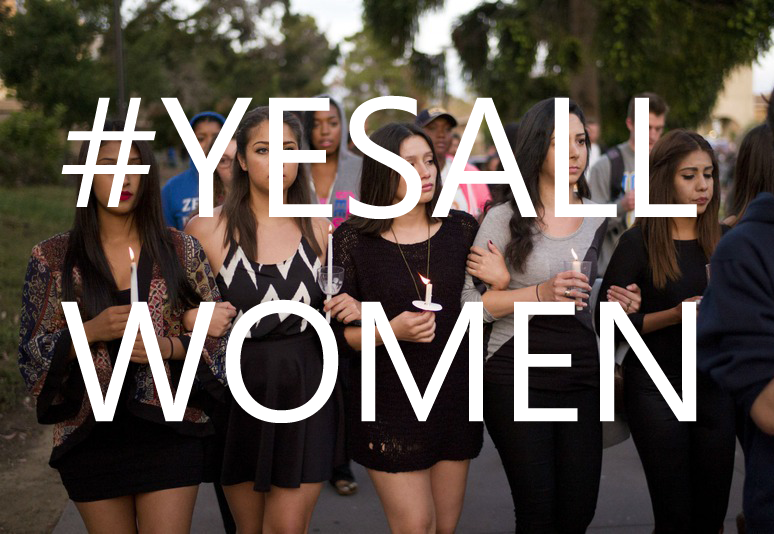
#YesAllWomen, the Darwin Debate, and the God Complex

The one thing I typically will always choose to do on the rare occasion that I’m able to sit down and relax is watch a documentary.  While some people may go to the gym, read a book, or hang with friends, I typically choose to stay in, nestle up on my couch, and learn.  While on my last bout of relaxation, I chose to watch the HBO documentary Questioning Darwin. Although it offers very little new insight into the evolution vs. creationism debate, it does offer an interesting new way to look at the recent social media hashtag war feminists, allies, and supporters found themselves in over the #YesAllWomen movement that took the world by storm.
yesallwomen
Now, before I discuss #YesAllWomen I have to admit that I did not enter into the safe space women created for themselves to tell tales of the horrible things they have and have had to face on a daily basis.  I firmly believe that men should not have entered into the digital space that women created to “voice” their opinions on a subject that women, specifically two women (writer Annie Cardi (@anniecardi) and one other, who has since made her profile private to protect herself and her identity), created.  Although I did see men chiming in as allies from time to time, the #YesAllWomen space proved more than ever that some men really can't just shut up and let women have a space all to themselves. The #YesAllWomen movement has become a tome of lived experiences where women were and are able to share the pain that they have, currently, or fear they will one day experience.  The troubling aspect of the hashtag activism that took place wasn't that women were openly talking about these horrible experiences but rather that the men, who openly engaged, accused, harassed, and ridiculed women (and some men) felt they had to do in order to defend themselves from stories that had nothing to do with them personally, but rather indirectly put their divinely sanctioned manhood under duress.
manhood
This leads us back to the main question – what does all of #YesAllWomen dialogue have to do with the HBO documentary Questioning Darwin?  Simply, 1 Timothy 2:13, that states: “For Adam was formed first, then Eve” and Genesis 2:18: “The LORD God said, ‘It is not good for the man to be alone.  I will make a helper [read: woman] suitable for him’” have led many men and women to become victims of a God complex that appears to have divinely ordained men to rule over women. While many of us have written about and refuted these biblical passages and norms, the sad and oftentimes painful aspect of the debate is that many communities and people, both young and old, believe these passages to be the literal word and wishes of God.  While the arguments in Questioning Darwin between creationists and evolutionists did not diverge from the same ones we have heard over time, the one argument that rose above the rest was that the men, who touted and blew their horns for the sake of creationism's significance, often stated that they (read: men) could never have evolved from a primate because they were not only to rule over them, as dictated in Genesis 1:28, but also because they, as men, were made in the image of God and therefore bestowed with certain divine rights and privileges that primates and those created as helpers (read:women) did not have.  This ultimately lead men to feel as if they were the oath keepers of some divine truth, both within and outside of scripture, that places them atop of the proverbial totem pole of life.
sistine-chapel-creation-of-adam
22-year-old Elliot Rodger, the author of “My Twisted World,” a 141-page manifesto that he created prior to going out on a shooting rampage in Isla Vista, California near the University of California Santa Barbara killing seven people and a major proponent for why the #YesAllWomen debate started, stated: “I would have an enormous tower built just for myself, where I can oversee the entire concentration camp and gleefully watch [women] all die…If I can’t have them, no one will…Women represent everything that is unfair in this world, and in order to make this world a fair place, women must be eradicated.” Rodger and his MRA (Men’s Rights Activist) elk all prove the point that men like him think and feel that women are not only objects that they can control but also can do away with at any given moment because they, like God, can do whatever they want.  They are the leaders of the world and therefore everyone else should just fall in line.

 The success of the #YesAllWomen movement isn’t that it openly allowed women the spaces to talk about their painful lived experiences and fears but that it helped them to prove the point that their safe spaces are oftentimes eradicated by the likes of Elliot Roger, Paul Elam, Anders Breivik, and many other individuals who feel it is their place to tell women what to do and inflict verbal, mental, and physical violence upon them if they don't listen.  #YesAllWomen proved that although not all men commit horrible crimes against women, the men that often get the headlines and create the most controversy are the ones that need to be watched out for. If you can or have the ability to stomach their various manifestos or read their tweets and blog posts, the one thing that will ring true above all else is that these men feel threatened by strong and empowered women and girls, who they truly believe to be both beneath them and ruining the world that they are to rule over with their feminist agendas.  Although a lot of these MRA and religious men like to think they are Gods, they in reality, after watching Questioning Darwin or reading tweets like the one below, are sometimes nothing more than a bunch of baboon’s asses contained in 140 characters. Although they like to admit that they did not descend from apes, they oftentimes can be found acting like a bunch of babbling baboons.
Photo